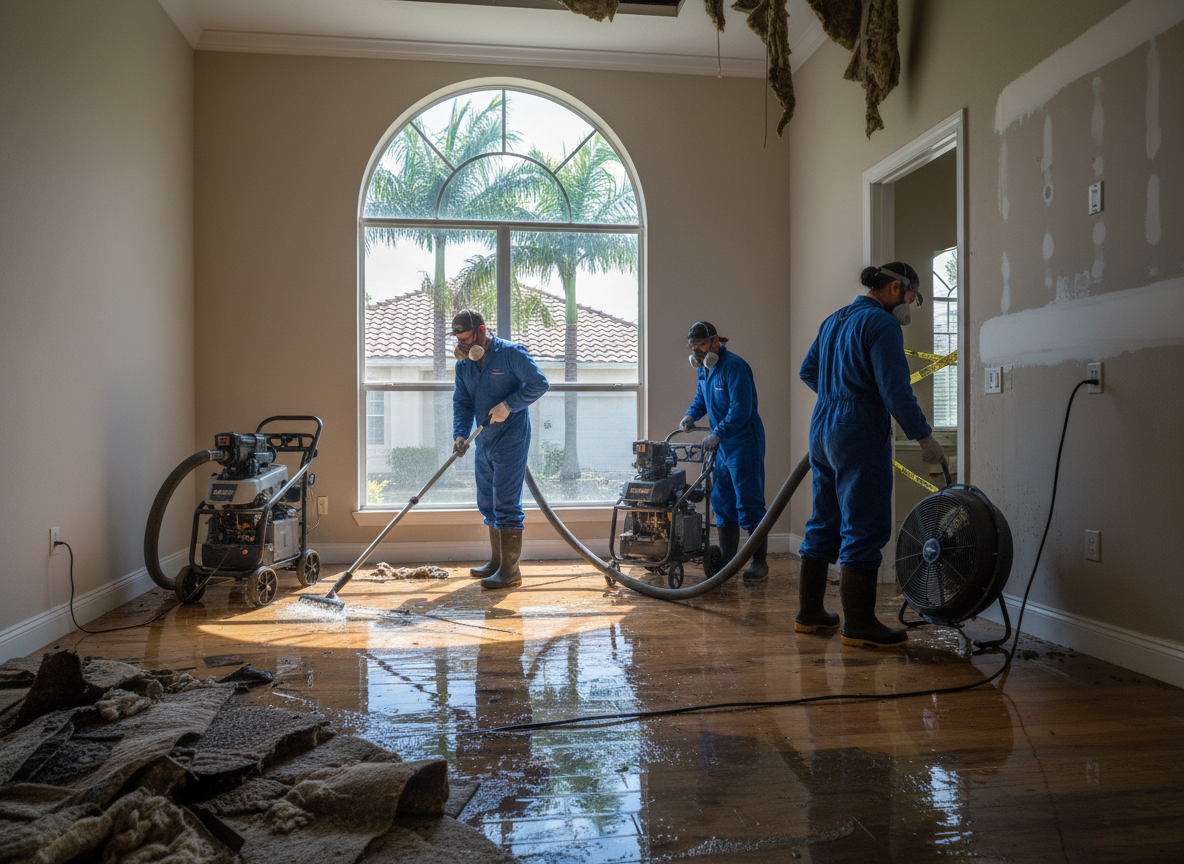
Royal Palm Beach is a village of about 39,000 people built on land that was swamp and natural preserve until a drainage project in the 1950s made it buildable. The village sits roughly fifteen miles inland from the Atlantic, so its water problems come from rain, canals and a shallow water table rather than from surf. This page covers how water damage in Royal Palm Beach is scoped.
What makes water damage in Royal Palm Beach different?
Royal Palm Beach is an inland village on drained land, with a canal network, a high water table and a housing stock that grew from the 1960s into the 1990s. Water arrives from rainfall and canal levels rather than storm surge, and it tends to sit in yards, swales and wall bases rather than run away.
A village created by drainage
Before the 1950s the land that became Royal Palm Beach was primarily uninhabited swamp and natural preserve, and it had been a Seminole hunting ground. Sam and Hattie Friedland, the Food Fair supermarket family, bought about 65,000 acres in the 1950s, and a massive drainage project followed. In 1959 the state legislature granted a charter naming the development Royal Palm Beach, and the village was incorporated on 18 June 1959. That origin still governs the drainage: the village depends on canals and control structures to keep the ground usable, and when those systems are full, water has nowhere to go. The village is about fifteen miles from the ocean, so storm surge is not the local risk; rainfall, canal levels and the water table are.
Housing from the 1960s to the 1990s
The first houses followed the drainage, and the village appeared on national fastest-growing lists in its size category in the 1980s. That means most of the housing is 1960s to 1990s construction, with a large share from the 1980s: ranch houses, villas and canal-front homes on slab foundations, with truss roofs and air handlers in closets, garages or utility rooms. The older sections near the original village centre have smaller lots and mature landscaping; the later subdivisions have retention lakes, cul-de-sacs and larger footprints. A canal-front house adds a specific path for water: a seawall, a dock and a bank that can erode or settle, and a pool deck or lanai that often sits lower than the house floor.
Canals, lakes and a high water table
The village is flat and the water table is close to the surface, which is what makes drainage necessary in the first place. The canals and retention lakes that make the lots buildable also set the level to which the ground can drain. In a wet season they run high, and water in a swale or a yard can stay there for days. The soil is sandy, so it drains quickly until it is saturated and then holds water near the surface. Homes here do not have basements, so water that gets under a slab spreads sideways to a wall plate or a cabinet toe, and a pool deck or lanai that falls toward the house sends water into the wall base every time it rains.
Who serves a Royal Palm Beach address
The Village of Royal Palm Beach is its own municipality, so building permits, right-of-way questions and local drainage run through the village rather than through Palm Beach County. The county publishes the flood maps used for insurance and runs countywide emergency management, and the regional canal system is managed at the water management district level. A flood-zone question and a permit question can therefore have two different answers from two different offices. We do not answer either on the village's behalf; we tell you what we found in the building and point you to the office that owns the record.
What do Royal Palm Beach homes actually need?
- Water restoration covers extraction, storm response, leak detection and drying for Royal Palm Beach homes, including the canal-facing walls and sliders that fail first.
- Mold remediation applies when a cavity, a closet or a wall behind furniture has stayed damp long enough for growth to appear.
Why use our Palm Springs crew in Royal Palm Beach?
Our base at 1990 Kirk Rd in Palm Springs is about nine and a half miles east of the village, so equipment reaches Royal Palm Beach on the same roads you use. What matters more is that we read the construction of this era and this setting properly: slab-on-grade, truss roofs, canal-front lanais, pool decks that fall toward the house and air handlers in closets. We write the scope before work begins, record readings at marked points and tell you plainly when the source repair belongs to a plumber, a roofer or a pool contractor. We do not publish licence numbers, certifications or reviews for Royal Palm Beach jobs, and we will not make them up.
Why Royal Palm Beach water damage gets worse quickly
The village's drainage works until it does not. In a wet season the canals and retention lakes run high, the ground stays saturated, and a wall base that took water on Saturday can still be wet on Wednesday. A damp slab keeps indoor humidity high in every room it touches, and the materials most likely to be affected are the ones you cannot see: drywall paper, insulation, wood studs and the back of a cabinet. In a closed house beside a canal, damp drywall and insulation can support growth within days rather than months.
Hurricane season runs from 1 June to 30 November, and the village's heaviest rain usually arrives in that window, often as afternoon thunderstorms rather than a named storm. The housing stock adds a second path: a 1980s air handler in a closet, a condensate line that has never been cleared, and a return plenum that stays damp all summer. Delay has a direct cost. Material that could have been dried is removed, cabinets that could have been saved swell, and a room that needed airflow for a few days needs containment and demolition.
Royal Palm Beach was incorporated in 1959 on land a developer had assembled in much larger parcels, and the village grew around a drainage plan rather than around the coast. That history matters after a storm: the canals that make the lots usable are also why a high water table can sit against a wall for days. Later subdivisions added gated entries, association-maintained common areas and uniform roof lines, so access and responsibility are part of the scope before any equipment arrives. Roughly fifteen miles inland, the village sees less surge than the coast and just as much rain.
How a Royal Palm Beach job runs, step by step
- Call and confirm access. Village addresses range from 1980s subdivisions to gated communities with their own gate rules, so we confirm the entry procedure and any HOA notice requirement before scheduling.
- Survey the canal-side assembly. Readings are taken at the wall base, around sliders and at the ceiling under a low-slope roof. Homes near a canal are read on the canal-facing wall as well as the interior partitions.
- Protect the house and notify the right people. Floors are covered, containment goes up, and if the home is in an association we document the work for the HOA as well as the owner.
- Extract, remove and dry. Standing water and saturated material come out, and drying runs on logged readings with the outdoor humidity recorded alongside the indoor target.
- Verify and hand back. Day-one and final readings are compared, the file is handed over, and the repairs that belong to a plumber, roofer or the association are named.
What's included on a Royal Palm Beach job:
- A written scope that separates the unit interior from association or common property
- Gate, HOA and access coordination before the first visit
- Readings at canal-facing walls, sliders and ceiling lines under low-slope roofs
- Extraction and removal of saturated pad, baseboard and drywall
- Cavity drying for frame-and-stucco walls built in the 1980s and later
- Photographs and a moisture log formatted for an insurer and an HOA file
- A hand-back that states which repair belongs to the owner and which to the association
Nearby areas we serve from Royal Palm Beach
The villages and cities closest to Royal Palm Beach are [West Palm Beach](/) to the east and Greenacres to the south-east, both within about ten miles of the village centre. Further east, we also work in Lake Worth Beach, Lantana, Palm Beach and the other Palm Beach County towns listed on this site.
What is the next step in Royal Palm Beach?
Call (561) 960-0937 and tell us the gate procedure, the address and where the water is. We will explain what to keep clear, what the association may need in writing, and what the first visit will cover.
Around Royal Palm Beach
We regularly work near:
- 📍Royal Palm Beach Commons Park
- 📍Royal Palm Beach Village Hall
- 📍Lighthouse Drive
- 📍Southern Boulevard
- 📍Wellington
Mold Remediation in Royal Palm Beach — Local Notes
- •Incorporated June 18, 1959
- •Built on land drained by a 1950s project
- •About 15 miles inland from the Atlantic
- •Most housing built from the 1960s to the 1990s