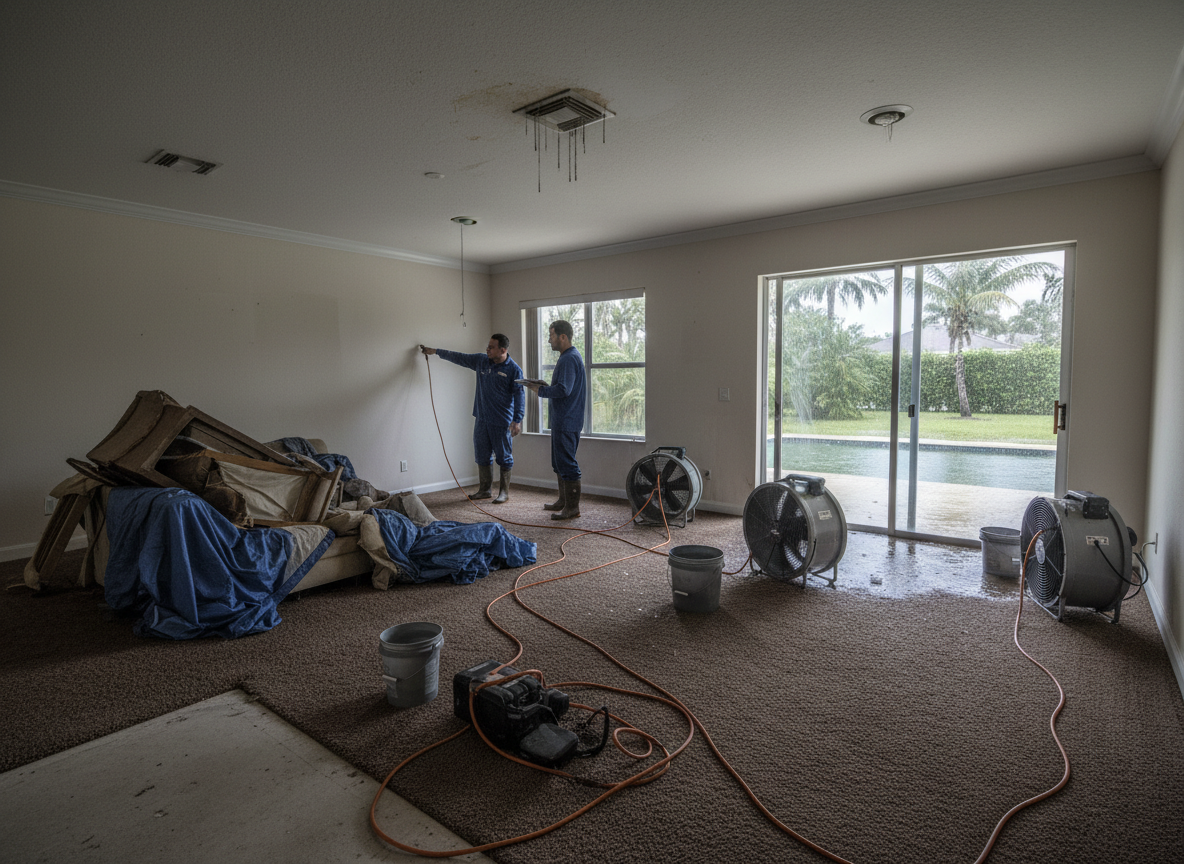
Lantana is a town of about 11,500 people on less than three square miles, and more than a fifth of that area is water. The Intracoastal side, the public beach and the low ground between them decide where water goes when it rains or when the tide runs high. That geography is the starting point for every water damage job in Lantana, and it is what this page covers.
What makes water damage in Lantana different?
Lantana is a small coastal town with an unusually high share of water within its boundary. The Intracoastal Waterway and the town's beach put tidal water close to low-lying streets, while the housing stock runs from 1920s cottages to post-war ranches and later condos.
A small town with a lot of water
Lantana was incorporated on 20 July 1921, when the town covered about one square mile and had around 100 residents. It grew after the Second World War, and Interstate 95 was completed through the town in the mid-1970s, which brought commercial development along the corridor. Today the town covers about 2.9 square miles, and 21.31% of that is water. The Intracoastal Waterway runs along the eastern side, the town has its own public beach, and the low ground between the water and the ridge is where rain and tide meet. Autumn king tides raise the Intracoastal without any rain, and a storm that pushes water up the lagoon can leave streets and yards wet for days. Flood maps are parcel-specific; the town's low eastern edge and its higher interior do not share the same exposure.
Housing from the 1920s to the 1980s
The town's housing reflects its growth spurts. The oldest cottages date from the 1920s and 1930s, the post-war years added small ranches and block homes, and the 1960s to 1980s brought condominiums and commercial buildings along the corridor. Lots are small and close together, and additions are common: a Florida room, an enclosed porch, a second bathroom carved out of a closet. Every addition leaves a seam where new plumbing meets old, and that seam is where water crosses from the new work into the original cottage. A cottage near the water and a 1970s condo on the same street hold water very differently, which is why the address matters more than the town name.
Low ground and a shallow water table
The town's eastern edge is low, the soil is sandy, and the water table sits close to the surface. A high Intracoastal reduces the capacity of the town's stormwater system, so water sits in yards and swales instead of draining. Salt from the lagoon is a second factor: it leaves residue in block and behind baseboards and pulls moisture from humid air, so a wall can read dry and then climb again. With no basements here, water under a slab moves sideways to a wall plate or cabinet toe, and a patio that falls toward the house feeds the wall base in every storm.
Who serves a Lantana address
The Town of Lantana is its own municipality, so building permits, right-of-way questions and local drainage run through the town rather than through Palm Beach County. Insurance flood maps come from the county, emergency management is run countywide, and the regional canal system sits with the water management district. A flood-zone answer and a permit answer can come from two different offices, and neither is decided by us. We do not answer for the town; we report what the building shows and name the office that holds the record.
What do Lantana homes actually need?
- Water restoration is where a Lantana loss starts: tide water, street flooding, a roof leak or a failed supply line, followed by drying that suits a small cottage or a later condo.
- Mold remediation follows where a wall cavity behind a baseboard, a Florida room or a closet has stayed damp after the water receded.
Why use our Palm Springs crew in Lantana?
Our base at 1990 Kirk Rd in Palm Springs is about five miles north-west of Lantana, so equipment reaches the town on the same roads you use. What matters more is that we read small-lot coastal houses properly: block and stucco walls, additions that tie new plumbing into old, Florida rooms with their own slabs and thresholds that sit close to the street. The scope is written before work starts, readings are logged at marked points, and a source repair that belongs to a plumber, roofer or the town is named as such. We do not print licence numbers, certifications or reviews for Lantana work, and we will not invent them to look established.
Why Lantana water damage gets worse quickly
The town's low eastern edge and shallow water table mean a wall base that took water on Saturday can still be wet on Wednesday, especially if the Intracoastal stayed high. A damp slab holds humidity in every room it touches, and the first materials affected are the hidden ones: drywall paper, insulation, studs and cabinet backs. With the Intracoastal close and the air already heavy, damp cottage walls can support growth within days rather than months.
Hurricane season runs from 1 June to 30 November, and the town's tidal exposure does not depend on a named storm. An October king tide can reach a door threshold with no rain at all, and a summer squall can drive water through a window head or roof edge. A house that has taken water once will usually take it again, and preventing the second event costs less than repairing it. Delay is expensive in a small cottage: material that could have been dried is cut out, cabinets that could have been saved swell, and a room that needed airflow needs demolition.
Lantana has been a town since 1921, when it covered about a square mile and held around a hundred residents. The Intracoastal, the public beach and the low ground between them still define where water goes. Autumn king tides are the local complication: they raise the lagoon without rain and can push water into yards, swales and the base of a wall while the sky is clear. Add a summer squall or a hurricane passing offshore and the same streets hold water for days. On lots this small, a neighbour's runoff and your own patio slope are part of the same problem.
Two streets can share a drainage path, so a blocked swale two doors down can keep a yard wet long after the rain stops. The town's mix of cottages, condos and small commercial buildings also means one storm produces very different losses on the same block.
How a Lantana job runs, step by step
- Call and name the source. Say whether the water came off the Intracoastal, up through the yard, off the roof or out of a fixture, and whether the town's low eastern streets are still holding water.
- Read the small-lot house. With cottages close together, readings go on shared walls, at the slab edge and behind the baseboard that faces the water. A dry reference comes from an interior partition of the same material.
- Protect the neighbour's side too. Floor coverings go down, containment is set away from the shared boundary, and exterior work is staged so runoff does not cross onto an adjoining lot.
- Extract, remove and dry around tide-driven humidity. Standing water is extracted, saturated material is bagged, and dehumidification runs with the outdoor reading logged, because a high Intracoastal keeps the whole block humid.
- Verify and hand back. Final readings are set against day one, and the roof, plumbing or town drainage item is named in writing rather than left open.
What's included on a Lantana job:
- A written scope that separates tide or street water from a plumbing loss
- Readings on shared walls and at the slab edge on small, close-built lots
- Extraction of standing water and removal of saturated pad, carpet and baseboard
- Cavity drying in 1920s cottages, post-war ranches and later condos
- Containment that keeps dust and equipment off a neighbour's boundary
- Photographs and a moisture log for an insurer or landlord
- A hand-back naming the roofer, plumber or town department that owns the next step
Nearby areas we serve from Lantana
The towns closest to Lantana are Lake Worth Beach, Greenacres and Palm Beach, all within about ten miles of the town centre. Further north, we also work in [West Palm Beach](/) and Riviera Beach; Atlantis and Ocean Ridge are both within about four miles of the town.
What is the next step in Lantana?
Call (561) 960-0937 and describe where the water is and whether the tide or the street is involved. We will tell you what to keep clear, which rooms to take out of use, and what the first visit will cover on a small lot.
Around Lantana
We regularly work near:
- 📍Lantana Beach
- 📍Lake Worth Lagoon
- 📍Lantana Road
- 📍Interstate 95
- 📍Bicentennial Park
Mold Remediation in Lantana — Local Notes
- •Incorporated July 20, 1921
- •2.9 sq mi, 21.31% water
- •Post-war building boom; I-95 completed through town in the mid-1970s
- •Intracoastal Waterway along the eastern side