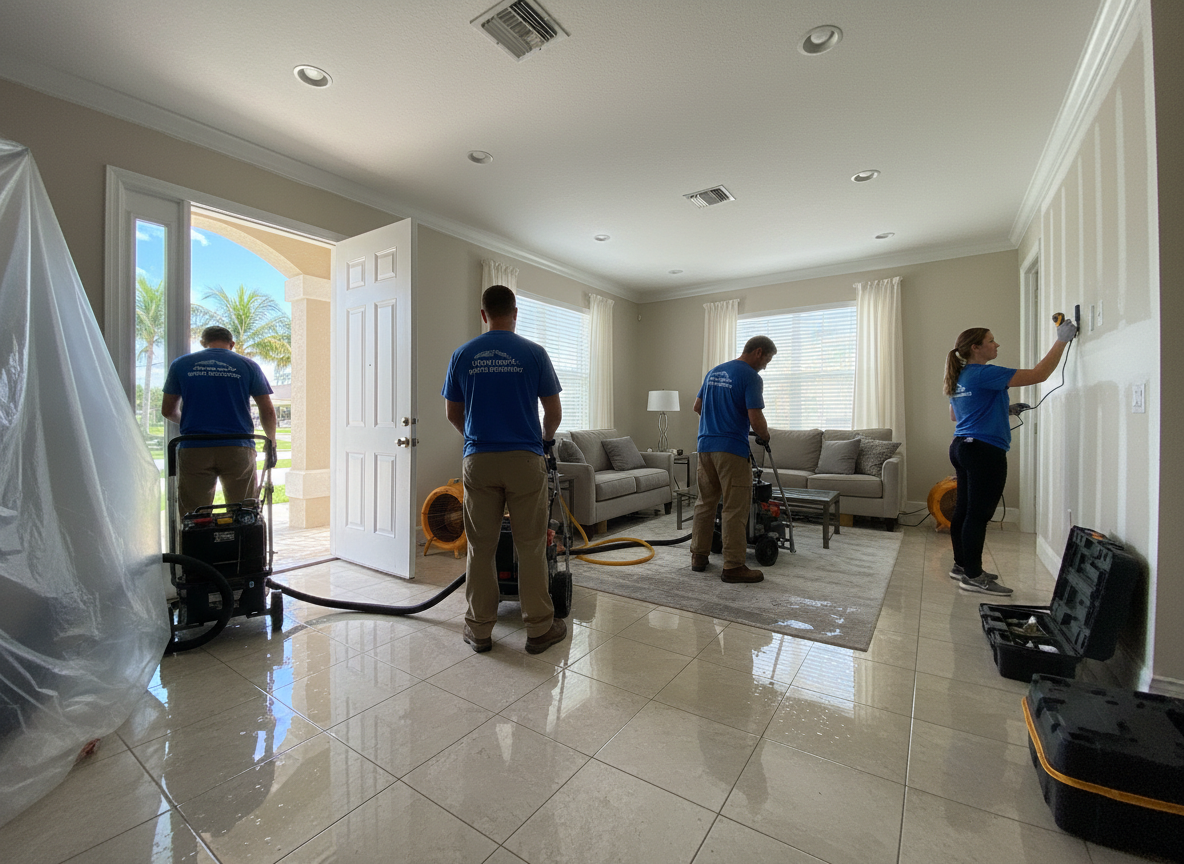
Palm Beach is an 18-mile barrier island town where the average elevation is about seven feet and some streets were built over former sloughs. When the Atlantic is pushed by a storm or the Intracoastal backs up on an autumn king tide, water does not need a plumbing failure to reach a house. This page covers what we look for on the island and how water damage in Palm Beach is scoped.
What makes water damage in Palm Beach different?
Palm Beach is a barrier island, so water arrives from the ocean, the lagoon or the ground rather than only from pipes. The town's average elevation is about seven feet, former slough areas are flood-prone, and the whole town sits in Evacuation Zone B. That combination shapes every job on the island.
An island with water on both sides
The Atlantic Ocean runs along the east side of the town and the Lake Worth Lagoon along the west, so a storm does not have to score a direct hit to cause a problem. The 1928 Okeechobee hurricane made landfall at Palm Beach with sustained winds reported at 145 mph, and the town has been shaped by coastal flooding since: parts of Ocean Boulevard flooded during the 1950s, and the former slough areas remain the low ground. Autumn king tides raise the lagoon without any rain at all, and a strong onshore wind can push ocean water over the beach and into the street. Flood zone and evacuation zone are parcel-specific questions, and the town sits inside Zone B as a whole, which is why the bridge closures and evacuation orders matter before the water does.
Houses built for a seasonal life
Much of the town's housing went up in the 1920s land boom, and the Mediterranean revival and mission-style villas of that era are still the defining stock: stucco over block, courtyards, guest houses, flat or low-pitch roofs and details that were designed for shade rather than for air-conditioning. Phipps Plaza, a tight ring of buildings from the 1920s to the 1940s, is a good example of how the island was built. Later infill brought 1950s and 1960s ranches and a set of apartment and condo buildings. A large share of the housing is seasonal, which changes the water risk: a house that is closed for months has no one to notice a stain, a drip or a smell until the owners return.
Sand, fill and a shallow water table
A barrier island is sand and fill sitting next to salt water, and the water table beneath it is close to the surface. That means heavy rain has very little ground to soak into before it meets saturated sand, and water moves sideways toward the lowest point rather than downward. The former sloughs are the places where that shows first. Salt is a second factor: floodwater from the lagoon or the ocean leaves salt in block, stucco and the gap behind a baseboard, and salt pulls moisture out of humid air, so a wall can read dry and then climb again. On the island, we read both sides of a wall where we can reach them, because stucco can look perfect while the block behind it is wet.
Who serves a Palm Beach address
The Town of Palm Beach is its own municipality, so building permits, right-of-way questions and local drainage run through the town rather than through Palm Beach County. Water and sewer service is provided by the City of West Palm Beach, which also supplies the mainland city across the lagoon. Flood maps and countywide emergency management come from Palm Beach County, and the bridges are the only way on and off the island, with the Flagler Memorial Bridge at the north end carrying traffic since 1938. We do not answer permit or flood-zone questions on the town's behalf. We tell you what we found in the building and point you to the office that owns the record.
What do Palm Beach homes actually need?
- Water restoration is where a Palm Beach loss starts, whether the water arrived with a storm, a king tide or a failed supply line. On the island that usually means reading the wall that faces the sea, the ceiling under a flat roof and the slab edge behind a terrace door.
- Mold remediation is the second stage when a closed seasonal house has stayed damp or a wall cavity never dried. Salt air alone does not grow mold, but it keeps surfaces damp long enough for a small leak to become a larger problem.
Why use our Palm Springs crew in Palm Beach?
Our base at 1990 Kirk Rd in Palm Springs sits west of the lagoon, so an island address means crossing a bridge and working within the town's access rules. That matters more than it sounds: narrow streets, limited parking, gate codes and delivery windows all affect how equipment reaches a house and how quickly a job can start. We plan the access before the crew leaves, read island assemblies for what they are, and write the scope before work begins. We do not advertise licence numbers, certifications or customer reviews for Palm Beach work, and we will not manufacture them for a pitch.
Why Palm Beach water damage gets worse quickly
A closed island house in July is a humid box. The air-conditioning may be set high or off, the interior surfaces stay cool, and humid outdoor air that gets in through a door seal or a vent condenses on walls, cabinet backs and ductwork. Add a slow supply-line weep, a roof flashing that only leaks in a squall, or a tide that left a baseboard wet, and the material can stay damp for weeks without anyone noticing. By the time the owners return, the smell is the first evidence.
Hurricane season runs from 1 June to 30 November, and the island's exposure is not only rain. Storm surge and king tides raise the lagoon, the bridges may close, and salt water that crosses a threshold leaves residue that keeps pulling moisture. Delay also has a practical cost: material that could have been dried is removed instead, and a seasonal house can lose a whole season to work that would have taken a week if it had started when the water first arrived.
How a Palm Beach job runs, step by step
- Call and plan the crossing. Tell us whether water came from the roof, a supply line, the beach side or a mechanical room. We check the bridge and the building's access rules before we load, because a barrier-island job is a schedule as much as a scope.
- Survey the island envelope. Readings go on both faces of exterior walls, around window heads, behind baseboards and at the slab edge, with a dry reference from an interior wall. Salt residue and seasonal closure both change what reads dry.
- Protect the interior before extraction. Floors, stairs and furnishings are covered, negative air is set where growth is likely, and we coordinate with the building manager or house manager on lifts, parking and hours.
- Extract, remove and dry against island humidity. Standing water comes out, unsalvageable material is bagged, and dehumidification runs with the outdoor reference logged, not just an indoor target.
- Verify, neutralise salt and hand back. Final readings are compared with day one, salt-affected surfaces are cleaned, and the repairs that belong to a roofer, plumber or builder are listed in writing.
What's included on a Palm Beach job:
- A written scope that separates storm or tide water from a plumbing loss
- Bridge-aware scheduling and coordination with building staff or a house manager
- Moisture readings on both faces of exterior walls and at window and door heads
- Salt-residue cleaning on block, stucco and metal fixings near the beach
- Containment and HEPA filtration where a seasonal house has stayed closed and damp
- Photographs and a moisture log for an insurer or property manager
- A hand-back that names the roofer, plumber or builder who owns the next repair
Nearby areas we serve from Palm Beach
The towns closest to the island are [West Palm Beach](/), Riviera Beach, Lake Worth Beach, Greenacres, Lantana and Atlantis, all within about ten miles of the town centre. Each page covers that town's own housing, drainage and storm exposure rather than repeating the island's.
What is the next step in Palm Beach?
Call (561) 960-0937 and say whether the water is rain, tide, salt spray or a pipe, and whether the house is occupied. We will tell you what to move off the floor, which rooms to keep clear, and how access over the bridge affects the first visit.
Around Palm Beach
We regularly work near:
- 📍Lake Worth Lagoon
- 📍The Breakers
- 📍Phipps Plaza Historic District
- 📍Flagler Memorial Bridge
- 📍Ocean Boulevard
Mold Remediation in Palm Beach — Local Notes
- •Barrier island town incorporated April 17, 1911
- •Average elevation about 7 ft; former slough areas are flood-prone
- •Entire town in Evacuation Zone B
- •Water and sewer provided by the City of West Palm Beach