Lake Worth Beach is a city of about 42,000 people whose eastern border is the Lake Worth Lagoon and whose municipal area is 13.51% water. That geography decides most of the water problems here: rain has little ground to soak into, the lagoon sets the level the storm drains discharge into, and a 1920s bungalow can take water at a wall base without a pipe failing. This page covers how water damage in Lake Worth Beach is scoped.
What makes water damage in Lake Worth Beach different?
Lake Worth Beach is a low-lying coastal city on the Lake Worth Lagoon, with a housing stock that runs from 1920s bungalows to post-war cottages and 1960s apartments. Water arrives from rain, from the lagoon and from plumbing that has been added to over decades, and the city owns the utilities that handle all three.
A city built around a lagoon
Lake Worth Beach was incorporated as the town of Lake Worth on 14 June 1913 and took its current name on 12 March 2019. The lagoon along its eastern border is the body of water the city is named for, and it opens to the Atlantic at the Port of Palm Beach. That connection matters in a storm: when the lagoon is high, the city's stormwater outfalls have less capacity, and water that would normally drain away sits in streets and against wall bases. The city has a long record of hurricane damage, from the 1928 Okeechobee hurricane through the 1947 and 1949 storms to Frances and Jeanne in 2004 and Wilma in 2005. Autumn king tides add a recurring, dry-weather path for water to back up into low streets near the lagoon.
A housing stock that starts in the 1920s
The city grew rapidly during the 1920s land boom, when its population more than quintupled, and the bungalows of that era are still a large part of the stock. The Old Lucerne Historic Residential District preserves a concentration of them, including houses built in the early 1920s. After the Second World War the city added smaller cottages and ranches, and the 1960s and 1970s brought apartments and condominiums, often on the site of older houses. The result is a city where a wood-frame bungalow, a block cottage and a 1970s condo can sit on the same block, and each one holds water differently. Older homes also tend to have plumbing that has been extended, patched and re-routed, which is why a leak can surface far from the fixture that caused it.
Sandy soil, a high water table and a city stormwater system
The ground under Lake Worth Beach is sandy and the water table is shallow, so heavy rain meets saturated soil quickly and moves sideways rather than down. The city's Water Utilities Department is responsible for drinking water, wastewater and stormwater collection, which means the drainage system that takes rainwater away is a municipal system rather than a county one. When the lagoon is high, that system has nowhere to discharge, and water can stand in a yard or a swale for days. Salt from the lagoon is a second issue: it leaves residue in block and behind baseboards and pulls moisture from the air, so a wall can read dry and then climb again.
Who serves a Lake Worth Beach address
Lake Worth Beach is its own municipality and, unusually for eastern Florida, it operates its own electric utility as well as its water and wastewater systems. The electric utility began in 1914 as the Lake Worth Water, Light and Ice Company and had about 27,000 customers as of 2019; by May 2021 more than 38% of the power it generated came from solar. For a homeowner, that means the city is the point of contact for permits, drainage, water, sewer and power, while Palm Beach County publishes the flood maps and runs countywide emergency management. We do not answer for the city. We read the building, tell you what we found and point you to the office that owns the record.
What do Lake Worth Beach homes actually need?
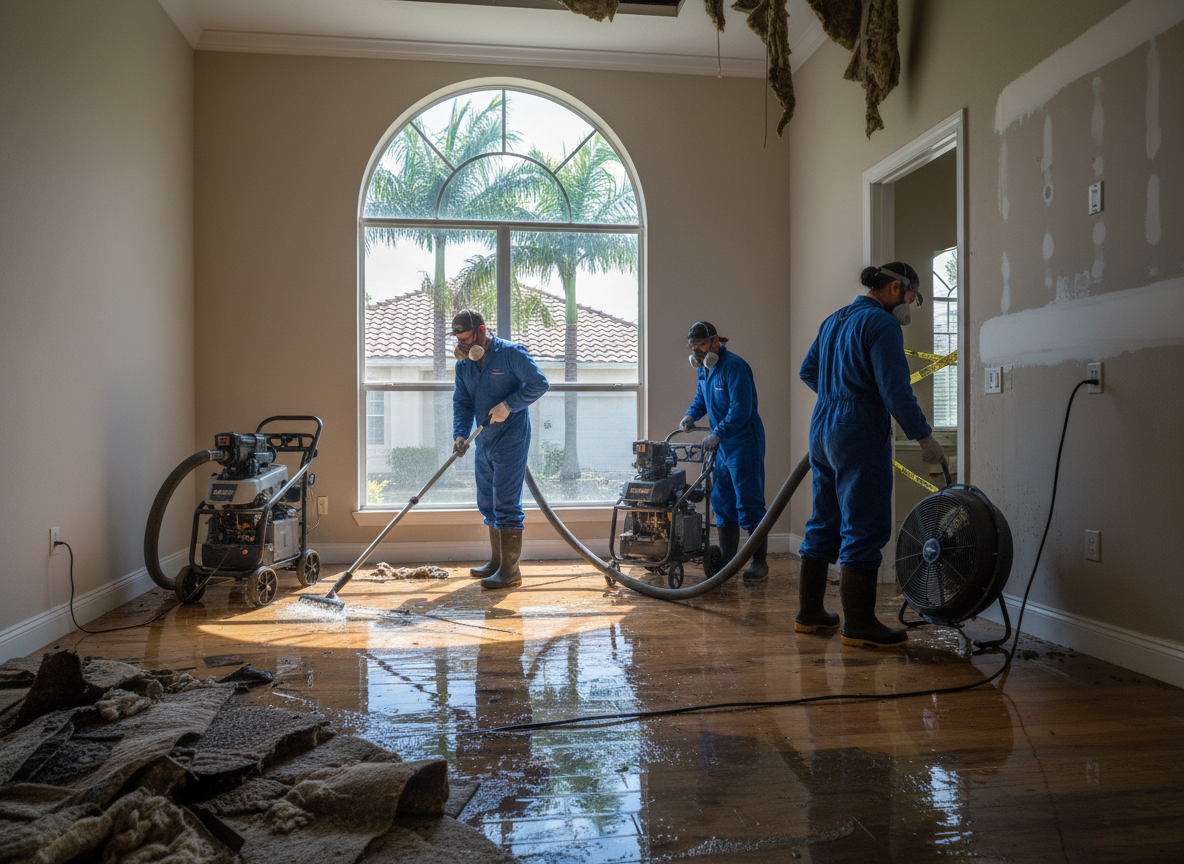
- Water restoration covers the first stage in Lake Worth Beach: water removal, storm response, leak detection and extraction, then drying that respects plaster and old timber. A lagoon-side cottage and a 1950s block house need different drying targets for the same wet room.
- Mold remediation follows when a wall cavity, a closet or the space under a raised floor has stayed damp long enough for growth to appear.
Why use our Palm Springs crew in Lake Worth Beach?
Our base at 1990 Kirk Rd in Palm Springs is about three miles west of the city, so equipment reaches Lake Worth Beach on the same roads you use. What matters more is that we read houses of this age every week: wood-frame bungalows with later additions, block cottages with stucco on both faces, and condo buildings where a shared wall or the unit below may be part of the loss. We write the scope before work begins, record readings at marked points and tell you plainly when the source repair belongs to a plumber or to the city utility. We do not print licence numbers, certifications or reviews for Lake Worth Beach jobs, and we will not invent them to win work.
Why Lake Worth Beach water damage gets worse quickly
The city's low ground and shallow water table mean a wall base that took water on Saturday can still be wet on Wednesday, especially if the lagoon stayed high. A damp cavity keeps indoor humidity up in every room it touches, and the materials most likely to be affected are the ones you cannot see: drywall paper, insulation, wood studs and the back of a cabinet. In a 1920s bungalow with no cavity ventilation, damp plaster and hardwood can support growth within days rather than months.
The season adds pressure. Hurricane season runs from 1 June to 30 November, and the city's history shows how often a second event arrives before the first repair is finished. Frances and Jeanne came in 2004, Wilma in 2005, and king tides return every autumn regardless of whether a named storm forms. A house that takes water once often takes it again, and the second time is cheaper to prevent than to repair. Delay also has a direct cost: material that could have been dried is removed instead, and a room that needed airflow for a few days needs containment and demolition.
How a Lake Worth Beach job runs, step by step
- Call and describe the entry point. Say whether water came through the roof, up from the street, out of a fixture or through a window during a squall. We ask about the age of the house and whether the electric panel is in the wet area.
- Read the old assemblies. Plaster, lath, Dade pine floors and 1920s plumbing all behave differently from modern drywall. Readings are taken at several heights and compared with a dry wall of the same era.
- Protect what can be saved. Furniture, art and flooring are moved or covered, and containment goes up before any demolition so dust and spores stay in one room.
- Extract, remove and dry slowly. Old dense plaster and hardwood release moisture slowly, so drying runs on recorded readings for as long as the material needs rather than a fixed number of days.
- Verify and hand back. Day-one and final readings are compared, salvaged material is documented, and the plaster, plumbing or roofing repair is handed to the trade that owns it.
What's included on a Lake Worth Beach job:
- A scope written for the era of the house, not a modern-build checklist
- Readings through plaster, lath, hardwood and original tile, taken at several heights
- Careful handling of architectural detail that is difficult to replace
- Containment and HEPA filtration where a bungalow has one bathroom and no hallway to work in
- Cavity drying for walls with no modern vapour barrier
- Photographs and a moisture log for an insurer or a historic-property file
- A written hand-back naming the plasterer, plumber or roofer for the next stage
Nearby areas we serve from Lake Worth Beach
The towns closest to the city are Lantana, Greenacres, Palm Beach and [West Palm Beach](/), all within about ten miles of the city centre. Each page covers that town's own housing and drainage rather than repeating Lake Worth Beach's lagoon story.
What is the next step in Lake Worth Beach?
Call (561) 960-0937 with the address and the era of the house, and tell us whether the water is from the roof, the street or a fixture. We will explain what to keep clear, what not to pull up before it is read, and what the first visit will cover in an older property.
Around Lake Worth Beach
We regularly work near:
- 📍Lake Worth Lagoon
- 📍Lake Worth Beach
- 📍William O. Lockhart Municipal Pier
- 📍Old Lucerne Historic Residential District
- 📍Downtown Lake Worth
Mold Remediation in Lake Worth Beach — Local Notes
- •Incorporated June 14, 1913; renamed Lake Worth Beach in 2019
- •6.81 sq mi, 13.51% water
- •City owns its electric, water, wastewater and stormwater utilities
- •Hurricanes in 1928, 1947, 1949, 2004 and 2005